MINJOK Essay
Koreans
are a group of people with a unique bond. Koreans are proud of their nation and
are very patriotic, but at the same time, they still try to accept diverse
culture from other countries. Koreans also unite surprisingly well, as seen during
the 2002 World Cup. In 2002, literally millions of Koreans rushed out into the streets
to cheer for the Korean soccer team, and showed how proud they were to be one
nation in a battle against many others. The question arises; what makes Koreans
so unique compared to other countries? The most fully encompassing (and vague)
concept that Koreans use to explain this phenomenon is the term “minjok.”
2002 World Cup Street Cheering
It is very hard to define minjok. The technical definition of minjok in the dictionary is “a group of people who have lived in the same area for a long time and developed their culture while living and sharing history together.” It is also said that synonyms for minjok can be “ethnic group” or “nation”. However, asking any Korean to confirm the definition above results in slight reserve and uncertainty. This is because, for Koreans, the term minjok usually has much more meaning than just simple ethnicity or nation. What makes the process of definition even harder is that, it most likely has a different meaning to everyone. A few concepts that minjok seems to vaguely include are patriotism, roots, and bonds. Considering how vague the heartfelt definition of the term is, one must ask what happened along the way in the course of history to ensue such a strong emotion while still being so hard to grasp in terms of definition.
Education
is one of the first places where most broad nationalistic concepts can easily
take root in a culture, so Korean education must play a role in defining
minjok. From a young age, Korean children are educated about nationalism. They
learn that they have to love one another and be proud of who they are. They
learn that one of the greatest features of Korea is that its people are all of
the same minjok. The most popular story among Koreans that is first learned is
the Danggun legend, which, in essence, dictates that all Koreans are descendants
of Hwanwoong and have the same roots. Because of the pride that Koreans have in
their ethnicity, they care a lot for other Koreans even when they are abroad,
and sometimes display uncertainty towards non-Koreans even when neighbors. The
theory that Koreans all originated from the same ancestor can be a big reason
why Koreans feel that they need to care about each other more, and be proud
that they are one of the few countries who have racial purity. The theme “We
are One” was extremely useful in uniting the nation and was emphasized several
times through tough times in Korean history. Being of one race or culture is a
characteristic not very common, but still not unique enough to fully describe
the uniqueness that the term “minjok” contains. Maybe delving deeper into
Korean history could reveal some useful clues to this nebulous definition.
Danggun Legend, the legend that ties Koreans together
Korea has
stayed a united country for a long time, and during that time, they have suffered
a lot. Right next door to Korea, there is China which has over the course of
about four thousand years attacked Korea countless times. To stand against
China, Koreans had to come together, and being the same minjok seemed to be the
factor that drove people to do so. For instance, during the reign of King InJo(1623-1649), Qing(China at the time)
attacked Chosun. After a humiliating loss, Korea fell into toadyism toward
China. Before choosing anything for themselves, Koreans always had to think
first about China and be respectful. Rooting from Confucianism and years of
disgrace, Koreans have developed a sort of victim mentality which bonded
Koreans even more. Because Korea suffered so much from foreign invasions, Korea
could have slowly developed an underlying abhorrence towards anything unknown.
<King InJo kneeling down>
Another example is during the period around Regent Heungseon Daewongun. A “closed-door” policy in diplomacy was used. The Regent wanted to make people come together and develop as a nation. Because Catholicism started to become prominent among some Koreans, he thought that the Korean identity was being threatened. He emphasized that Korea has to keep its minjok pure, and so he used a national isolation policy. It was taken to such extremes that there is an interesting incident involving a Dutch who accidently came to Korea. Dutchman Hendrik Hamel had to stay in Korea for 14 years since Korea worried that he might spread some facts about Korea. This shows how closed Korean society was and, in a sense, how the “minjok” bond was so strongly used to promote closeness within its society.

Foreigners like Hendrik Hamel were forced to do manual labor
The best example of knitting people’s sense of unity close was at its peak during Japanese Imperialism. It is recorded that Japan tried to take away all the effects of minjok on Korean mentality. Japan tried to destroy the native culture and make everything Japanese by promoting Great East Asian Co-Prosperity. However, Koreans tried to hold on to their identity. Drastic times bring forth strong thinkers, and historian Shin Chae-Ho emerged during that time, and is said to be have defined the concept of minjok as fully as possible. He emphasized Korean history and minjok and tried to keep nationalism even though Japan was trying to uproot Korean identity. Also at that time, there were Donghak movements, and neo-Confucianism, which gathered huge crowds to fight against Japanese Imperialism. The term minjok was the unifying concept which provided the fuel for all the actions taken against the Japanese, for Korean independence. This must mean that after Korea got its independence, and there wasn’t any common non-Korean enemy left, the concept loses its relevance. However, that was not the case.
The term actually
became extremely popular during the regime of president Park Jung Hee. In order
to lead the economic growth of Korea, he emphasized that all Koreans have to
work hard for their beloved country because, again, as the slogan says, “we are
one.” The word minjok was something that easily grouped people together, and
President Park probably knew that and used it to his advantage. North Korea
couldn’t be specified as a common enemy against minjok, North Korea was still
technically the same minjok. Poverty, on the other hand, was a strong enough
single common enemy against the well being of the Korean minjok. Hence, it was
defined and used in that way. It brought Korean people together, and it has
been so deeply rooted in everyone’s minds that that’s why it is such important
part in Koreans’ minds even to this day. This conclusion shows that the term is
what has been used to fight a common enemy whether it’s economical or a
tangible enemy invasion. Does that mean minjok is simply just a silent
battlecry towards the undesirable?
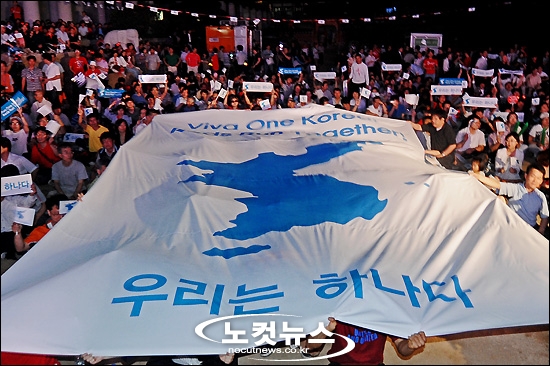
"We Are One"
Historically, Koreans used to be very conservative. Whether it’s
because of Confucianism, patriotism, or just simple xenophobia, many Koreans
today seem to be very displeased with foreign culture. Granted, there were many
difficulties that Korea as a whole nation suffered throughout, and those
hardships bonded people very strongly. However, it seems anachronistic that
there are still people who shun foreigners and refuse to accept them into
Korean culture because they think foreigners do not understand the hardship
Korea has gone through in the past 4,300 years. Using minjok to justify
xenophobia seems parochial at best, so perhaps there are other instances and
implications that show the contemporary concept of minjok used in a more
positive sense.
“Segyehwa,” or Korean Globalization, could happen because Koreans
worked as a unit of minjok and accepted the integration of other diverse
cultures while keeping nationalism and pride inside their hearts. This leads to
the attitude of Koreans in the 21st century. Korean
society is in the stage of constant change, accelerating with every passing
day. Korea is accepting more open and global visions. Korean globalization is
taking place very rapidly, and the sheer number of global corporations,
import/exports, and immigration/emigration showing near significant growth year
after year supports this. Also, many Korean students prepare for university and
graduate programs abroad. There is such a demand for this trend that there are
GLP(global leadership program)s in other special high schools such as Daewon,Boogil, and HAFS, as well as the international program right here in KMLA. Does
this mean that the 21st century generation of students have
abandoned their mother country and its culture, thus abandoning their “minjok?”
Has the term lost its relevance in the age of social networking, high-speed
internet, and quad-core smartphones?
It is
certain that the term “minjok” in the 21st century is not something
that restricts people from contacting other ethnic people. It is mostly thought
as a term that explains why Koreans have nationalistic pride as default. In the
past, the word “minjok” usually meant the same bloodline having the same root.
However, it seems to have now turned into a more cultural term. There are many
TV programs, movies, and books promoting and accepting ethnical diversity. This
trend has never been around until recently in the 21st century. This
acceptance of immigrants is most likely at its strongest now, and will only get
stronger as time passes. The term minjok is slowly seeing change in its
definition as well. Simply stating that it now means the “community” is not
analytical enough especially considering the history the nation has been
through. Some TV shows featuring foreigners speaking Korean and acting Korean
doesn’t change such a deeply rooted conceptual term. That means there must be a
common ground between the old usage of the term and the current usage of
minjok.

Top: Total Marriage
Middle: International Marriage (INCREASING)
This shows that Korea is now gradually being globalized

Top: Total Marriage
Middle: International Marriage (INCREASING)
This shows that Korea is now gradually being globalized
The
simplest explanation is usually the most logical (as Occam’s Razor states) and
once the ironclad idea of “blood” is taken out of the equation, there is a
definition worthy of recognition. Even if the idea of “bloodline” is excluded,
the definition still stands. The people of Korea and the history and culture
they share is still yet the single most important factor in describing minjok,
but even without blood ties, the sense of community still stands true. In the
past, people just didn’t have the means to travel as much as they do now, and this
gave them more time to spend with each other making the affiliation seem more
pre-destined, and less circumstantial. However, considering the fact that the
people of Korea today generally share the same genes and history as the people
in the Chosun dynasty (and the dynasties prior) and the fact that people tend
to include non-native Koreans into the minjok umbrella, maybe it wasn’t just
about the shared DNA, and preserving it for future generations. Maybe it’s more
about what culture and mindset people share, and how they can unite as one when
the occasion necessitates it. Maybe it’s a term that other nations also have,
but just named differently. Nevertheless, in Korea, it’s called minjok, and it
will be called minjok and will be guarded and preserved at all costs, because,
well, we’re all minjok.


0 개의 댓글:
댓글 쓰기